93 stories
·
0 followers

Yes, Net Neutrality Is Being Stolen From Us in a Fucked Up, Undemocratic Heist

1 Share

These are the facts: Millions of Americans have asked the Federal Communications Commission to keep its current net neutrality regulations, which protect the free and open internet. These regulations were enacted as a result of decades of hearings, meetings, and legal battles. They have broad bipartisan public support. The current regulations have been upheld in court. They have not decreased investment in broadband, according to broadband companies themselves. And they are about to be dismantled.

FCC Chairman Ajit Pai has called those fighting to protect the open internet “hyperbolic” and “desperate.” He reads “mean tweets” to create viral hate clicks for conservative publications, jokes about being an industry shill at the “Telecom Prom,” and says Hollywood celebrities are the reason everyone is so riled up. His public pitch for repealing the regulations—to the extent that there is one at all—often boils down to suggesting that people who want the regulations to remain in place are hysterical or are overblowing the situation.

But you’re not hysterical: This is an undemocratic looting by telecom monopolists and an FCC commissioner who has shown no interest in engaging with the people of this country, let alone serving their best interests.

A poll released this week by the Program for Public Consultation and Voice of the People at the University of Maryland found that 83 percent of Americans—and 75 percent of Republicans—favor the current system (the group that conducted the poll clearly explained the current regulations as well as the proposed ones). Pai, meanwhile, has said that “volume and vitriol are not substitutes for actual arguments” and has stated that “desperate” people are raising “hyperbolic fears” about net neutrality violations that “never materialized before 2015.”

The “actual argument” for net neutrality that has been made, time and time again, is that without regulations that require ISPs to treat internet infrastructure as a data- and content-neutral pipe, they will be empowered to pick which types of websites and web services get preferential treatments on their networks. There are many examples of this already happening: AT&T blocking FaceTime and Comcast blocking BitTorrent are among the most famous.

But one need not understand net neutrality or telecom policy in order to realize that what the FCC is doing is both highly unusual and extremely fucked up:

  • The FCC has declined to participate in a New York State attorney general probe into irregularities in the agency’s commenting process. There is public evidence that shows approximately a million stolen identities—including those of dead people—were used to support the FCC’s proposed net neutrality rollback.
  • The FCC is being sued for not responding to Freedom of Information Act requests about net neutrality.
  • Pai has said that there is no evidence that telecom companies violated net neutrality prior to the 2015 regulations. In addition to the Comcast and AT&T examples I listed above, here is a long list of telecom companies violating net neutrality prior to 2015. Comcast, meanwhile, has quietly removed a promise to honor net neutrality principles on its website.
  • Pai’s FCC has also failed to enforce the current regulations as telecom companies use zero rating to favor video and music streaming services that they own or partner with. More than 50,000 consumer reports of net neutrality violations since 2015 have been ignored in the public comment process.
  • Pai, the FCC, and telecom companies have falsely stated that net neutrality protections prevent telecom companies from using dedicated bandwidth for telemedicine that could help people who are sick and disabled. There is, in fact, a massive carveout in the current regulations that exempt companies from the rules for telemedicine services.
  • Pai, the FCC, and think tanks funded by telecom companies have stated that net neutrality regulations have hurt broadband investment; telecom companies have told their investors that investment is increasing.
  • Pai and the FCC have claimed that net neutrality regulations have hurt small ISPs, but have presented no data to back up this claim, and data that is available suggests the opposite is true.
  • Technologists involved in the creation of the internet and its protocols said that Pai’s net neutrality repeal is “based on a flawed and factually inaccurate understanding of internet technology.”

“Procedural irregularity is really easy to spot,” Cory Doctorow, co-founder of BoingBoing and an activist with the Electronic Frontier Foundation who has been involved in the net neutrality fight for years told me. “When people act in ways that discredit the democratic process—when they throw away millions of comments—one after another after another of garbage people tactics—it’s easy for people to take the rule of thumb that shenanigans are usually there to mess me over, and say, ‘OK, this is definitely something that’s messing me over.’”

So no, you’re not wrong: This is a heist that is in line with a party and administration that has found itself in the temporary and tenuous position of being able to gift wrap tremendously unpopular legislation and regulatory rollbacks to corporate donors before a wave of progressive backlash gains the electoral clout necessary to turn off the faucet.

It is governance that rewards an industry that has spent a decade setting up an apparatus propped up by astroturf advocacy groups, think tanks they have funded, politicians they have bought, and a persistence that is only possible with an army of lawyers and unfathomably deep pockets.

There is little time to stop Thursday’s vote, but the millions of people who have fought to protect net neutrality should know that they were not wrong to speak up. They should remember the style of governance that allowed this to happen and vow to remove it from power as soon as possible.


Read the whole story
pgilmore
3097 days ago
reply
Ystad, Sweden
Share this story
Delete

Remote keynote offer (because the world needs less business trips)

1 Share

OK here’s an offer to any conference organizer in the lean/agile/tech/climate space. I get a lot of requests to do conference keynotes, which I’m grateful for, but unfortunately I have to turn down the vast majority. I limit long-distance travel for family reasons, and also for climate reasons (although I confess I’m in Thailand right now as I write this…. hard to be 100% consistent…).

Now I’m thinking: Why should something as mundane as physical transport get in the way of participating in a great conference? And, in this world of catastrophic climate change, shouldn’t most business trips be replaced with remote participation?

My hypothesis is that it’s possible to remote-participate effectively in a conference –  to do a keynote or talk, participate in workshops, even hang out with people in the hallway. I’ve tried this a few times using video conference and telepresence robots. In fact, 4 years ago I was sitting on this same beach in Thailand, remote-participating in a Spotify event in Stockholm using a Double (see “What it feels like being an ipad on a stick on wheels“). That was fun and a bit clunky, but it was 4 years ago so I bet the telepresence robots have come a long way since then!

So here’s my offer:

  • I’ll do remote keynote (or similar) at your conference or event outside Sweden, and participate for a full day (or half day, depending on time zone).
  • I’ll do it at half my usual keynote fee (usually around €8000-€15000, so half of that).
  • That saves you thousands of € that you can instead invest in a top-of-the-line remote telepresence robot, for example Beam or Double. Technology you can keep and reuse, instead of wasting money moving a physical body from A to B plus accomodation.
  • No skimping on quality. If we’re going to do this, we do it well. Iron-tight internet connection, great hardware and software, and a plan for how I’ll navigate obstacles like stairs and elevators.
  • Money back guarantee. If you did your best with the tech setup and things still turn out kind of crappy for whatever reason (which is a real risk), I’ll just charge whatever you think it was worth (even if it was 0).

Think of it as an experiment. If it works well, hopefully the practice will spread, and people will save travel money while also helping the climate.

If you are interested, feel free to reach out to henrik.kniberg at crisp.se, or comment below.


Read the whole story
pgilmore
3099 days ago
reply
Ystad, Sweden
Share this story
Delete

The Dangers of American Sexual Prudishness

1 Share

Is the US the world’s most uptight nation regarding sex? Maybe not the most, but certainly among them. For example, the US has more laws regulating sexual behavior than all European countries combined. US prudishness is so severe as to be deadly. To end sexual violence and harassment against women, something has to change.

Is America the World’s Most Uptight Nation When It Comes to Sex?

Less than half of girls and boys in the US have received the HPV vaccinations that can protect them from deadly cancers. Why? Because HPV is a sexually transmitted infection (STI), and discussing teen sexual activity is taboo. Many doctors refuse to recommend the vaccine because they are uncomfortable discussing STIs.

Related to this prudishness is the view that women’s bodies are purely sexual and therefore all female nudity is provocative and shameful. Even public breastfeeding makes most Americans uncomfortable because a woman’s breast is exposed.

This prudishness about women’s bodies claims to be “protecting” women. At its heart, however, it is about power rather than sex. The “protection” it provides is both seductive and insidious. Seductive, because many women find it comforting to imagine that men are protecting them from danger, even strangers such as legislators—insidious in its implications.

Whom do we protect? Children and adults who are too young, inexperienced, weak, or incompetent to protect themselves. Putting a normal adult woman into this category disempowers her, ensuring that someone else can dictate the most intimate conditions of her life: how she dresses, where she can go alone, whether she has final authority over her own body.

Prudishness also justifies a perceived division between “good” and “bad” women. The former are  modest, compliant and “covered up.” The latter, bold, proud, and independent. That separation buttresses men’s sense that they can treat “bad” women badly. Because the women are “out there,” they can be objectified, attacked, harassed, groped. The result is evident, as the tidal wave of sexual violence and harassment reports continues to grow.

Despite broad recognition of this public health epidemic and dedicated efforts to end sexual violence and harassment, few programs have been successful. The problem is that they are fighting an uphill battle against the prevailing social mores described above. If men are inherently more powerful than women and can define “good” and “bad” women, the only way to end sexual assault and harassment is to convince men they should not assault women. Otherwise, the only option is to mitigate the impact by convincing bystanders to intervene, or training women to defend themselves.

We need a completely new approach. Let’s consider societies with two striking cultural differences from the US. These cultures hold that women are equal to men and that women, from teenhood, should have complete control over their own bodies.

Consider the Kreung society of the lovely Ratanakiri (“Mountain of Jewels”) Province in Cambodia. The Kreung believe that healthy, loving marriages require women who are strong, self-assured, and have self-confidence about their sexuality. Parents help each teen daughter achieve this state by giving her a room of her own. She can invite a boy she likes to spend the night in her room. There, she makes all the rules and reigns supreme. Will they talk the night away? Sleep? Cuddle? Have sex? She alone decides. In this completely secure space, she is free to explore her own sexuality, to discover what pleases her. When she says, “No,” he obeys instantly, without argument or bad feelings. A boy who flouts this rule faces severe penalties from the entire community, as do his parents.

Take another interesting group, the Vanatinai, a small island society off New Guinea. There, women and men are equal in all major aspects of life: decision-making, ritual practices, spiritual power, property holdings, and sexual activity. By working hard to gain goods and giving them away through ritual generosity, anyone of any sex can become one of the authoritative and influential leaders known as “gia”. Everyone is free to engage in sex before marriage, to end a marriage, and to marry as often as, and with whomever, he or she wishes.

The result? Divorce is rare in these societies; sexual violence virtually unknown.

The Takeaway

Sexual violence and harassment are rooted in the very foundations of culture. It is not enough to tell men they should not indulge, or bystanders that they should intervene, or women that they should protect themselves. Ending sexual violence and harassment requires a fundamental shift in cultural attitudes and values, beginning with equality between women and men, and women’s complete control over their own bodies. This change includes ending the putative “protection” of women—including laws to restrict abortion, to regulate women’s attire in ways that are different from those for men, or other social and legal constraints that claim to “protect” but actually disempower and diminish women. Only such basic cultural and legal changes will make it possible to end sexual violence and harassment against women.

References

Cdc.gov. (2017). Sexual Violence: Prevention Strategies. [online] Available here.

Lepowsky, M. (1993). Fruit of the motherland. New York: Columbia University Press.

Mullin, E. The Cancer Vaccine That Too Many People Ignore. (2017). MIT Technology Review, 120 (6), pp.16-17.

Muong, V. (2014). ‘Love huts’ of Ratanakiri minorities: Is a tradition quietly slipping away?. The Phnom Penh Post.

Procida, R. and Simon, R. (2007). Global perspectives on social issues. Lanham, Md.: Lexington Books.

Image via frolicsomepl/Pixabay.

Read the whole story
pgilmore
3100 days ago
reply
Ystad, Sweden
Share this story
Delete

Medicinal Plants and the Brain — St. John’s Wort, Skullcap, and Ashwagandha

1 Share

Medicinal plants still comprise a nebulous cloud in biomedical science. We know they have been used since the dawn of man, but there are precious few good quality scientific studies that support their use. Unlike pharmaceutical drugs, plant medicines consist of many different molecules that interact together in the body to have a variety of, poorly understood, pharmacological effects. Despite variably successful attempts to identify single molecules in plants for drug development, we should acknowledge that the whole is greater than a single part. There is an increasing number of clinical studies which strongly imply that root, leaf, and flower extracts of medicinal plants can influence the brain and are effective at treating cognitive disorders. This article series will examine plants where we have double-blind, placebo-controlled studies to support their medicinal influence on the human brain.

St. John’s wort is a commonly known plant that is native to Europe and yields bright yellow flowers. Its name comes from flowering around St. John’s day on the 24th June. St. John’s wort has been used as long ago as the ancient Greeks, and the physician Dioscorides (40–90AD) used it in the treatment of sciatica. However, St. John’s wort has become known as less of a treatment for nerve pain and more so for depression, with multiple double-blind, placebo-controlled trials confirming its antidepressant properties. Authors typically compare St. John’s wort with mainstream anti-depressant drugs and find it has a preferable side effects profile. It is not without its downsides however, as excessive use has been linked to serotonin syndrome, sun sensitivity, and easy skin burning, and more generally with increased pharmaceutical drug metabolism by the liver. This means St. John’s wort may not be suitable for applications alongside other pharmaceutical drugs, and it is contraindicated with serotonin reuptake inhibitors.

American skullcap is a member of the mint family that is native to North America and grows wild in meadows and swamps. It was used by the Native Americans as a sedative and America’s 19th century physicians, the Eclectics, widely used the herb for complaints involving an overactive nervous system such as insomnia, anxiety, and epilepsy. A human double-blind, placebo-controlled study supports skullcap’s application against anxiety, and a mood elevating effect has also been noted. Herbalist’s view both St. John’s wort and American skullcap as ‘nervine tonics’, meaning that they act upon the nervous system medicinally and are also considered to have a long-term renewing effect. While, this claim is yet to be verified by scientific studies, it certainly warrants further investigation.

Ashwagandha, the root of which is a popular home remedy in India, is a plant native to India that is mentioned in the traditional Ayurvedic medical text, the Charaka Samhita, approximately 2000 years ago. Here it is recommended as a tonic for emancipation, reproductive ability, and longevity. In Ayurveda, it is classified as a ‘rasayana herb’, a class of plant that are considered to restore and support long-term health and that overlaps to some degree with the Western definition of a ‘tonic herb’. Two double-blind, placebo-controlled human studies support ashwagandha’s role in the reduction of anxiety. It’s wide-ranging medicinal properties are supported by two additional well-controlled, human clinical studies on osteoarthritis and subclinical hypothyroidism. The emerging picture is that ashwagandha possesses a wide range of medicinal properties that will likely be better understood in the future. Ashwagandha has been well-tolerated across clinical trials, with a side effect profile similar to placebo.

References

Auddy B, Hazra J, Mitra A, Abedon B, and Ghosal S. A standardized Withania somnifera extract significantly reduces stress-related parameters in chronically stressed humans: A double-blind, randomized, placebo-controlled study. J Am Nutraceutical Assoc. 2008;11:50–6. Access here.

Brock C, Whitehouse J, Tewfik I, and Towell T. (2014). American Skullcap (Scutellaria lateriflora): A Randomised, Double-Blind Placebo-Controlled Crossover Study of its Effects on Mood in Healthy Volunteers. Phytotherapy Research, 28(5), 692-698. DOI: 10.1002/ptr.5044

Castleman, Michael. “The new healing herbs.” Bantam Book, New York (2001): 465-471. ISBN: 1605298891

Chandrasekhar K, Kapoor J, and Anishetty S. A prospective, randomized double-blind, placebo-controlled study of safety and efficacy of a high-concentration full-spectrum extract of ashwagandha root in reducing stress and anxiety in adults. Indian Journal of Psychological Medicine 34.3 (2012): 255. DOI: 10.4103/0253-7176.106022

Dannawi M. Possible serotonin syndrome after combination of buspirone and St John’s Wort. Journal of Psychopharmacology 16.4 (2002): 401-401. DOI: 10.1177/026988110201600420

Hoffman, David. Holistic herbal. Element Books, 1988. ISBN: 1852300248

Laakmann G, Schüle C, Baghai T, and Kieser M. St. John’s wort in mild to moderate depression: the relevance of hyperforin for the clinical efficacy. Pharmacopsychiatry 31.S 1 (1998): 54-59. DOI: 10.1055/s-2007-979346

Markowitz JS, Donovan JL, DeVane CL, Taylor RM, Ruan Y, Wang JS, and Chavin KD. Effect of St John’s wort on drug metabolism by induction of cytochrome P450 3A4 enzyme. Jama 290.11 (2003): 1500-1504. DOI: 10.1001/jama.290.11.1500

Ramakanth GS, Uday Kumar C, Kishan PV, and Usharani P. A randomized, double blind placebo controlled study of efficacy and tolerability of Withaina somnifera extracts in knee joint pain. Journal of Ayurveda and integrative medicine 7.3 (2016): 151-157. DOI: 10.1016/j.jaim.2016.05.003

Scudder, John. Specific Medication and Specific Medicines, 1870. ISBN:

Sharma AK, Basu I, and Singh S1. Efficacy and Safety of Ashwagandha Root Extract in Subclinical Hypothyroid Patients: A Double-Blind, Randomized Placebo-Controlled Trial. The Journal of Alternative and Complementary Medicine (2017). DOI: 10.1089/acm.2017.0183

Szegedi A, Kohnen R, Dienel A, and Kieser M. Acute treatment of moderate to severe depression with hypericum extract WS 5570 (St John’s wort): randomised controlled double blind non-inferiority trial versus paroxetine. Bmj 330.7490 (2005): 503. DOI: 10.1136/bmj.38356.655266.82

Woelk, Helmut. Comparison of St John’s wort and imipramine for treating depression: randomised controlled trial. Bmj 321.7260 (2000): 536-539. PMCID: PMC27467

Wolfson P and Hoffmann DL. An investigation into the efficacy of Scutellaria lateriflora in healthy volunteers. Alternative therapies in health and medicine 9.2 (2003): 74. PMID: 12652886

Image via kerdkanno/Pixabay.

Read the whole story
pgilmore
3102 days ago
reply
Ystad, Sweden
Share this story
Delete

This Interview Was Conducted on an Anonymous, DIY Cell Phone Network

1 Share

Most people in the United States—and increasingly, around the world—carry the most sophisticated surveillance devices ever created in their pockets day in and day out. Although smartphones have enabled governments and corporations to track our movements and monitor our conversations with unprecedented ease, these devices are also an incredibly useful personal tool and have become an indispensable part of modern life.

It’s a crappy trade off, but evidently one that most of us seem OK with. But Denver Gingerich, a programmer based in New York City, doesn’t see why we can’t have our smartphones and our privacy, too.

For the past few years, Gingerich has been laying the groundwork for Sopranica, an open source, DIY cell network that allows smartphone owners to make calls, send texts and eventually browse the internet with total anonymity.

In January, Gingerich published the code for the first part of Sopranica called JMP. This is essentially a way of using a secure instant messaging protocol called XMPP, better known as Jabber, to communicate over voice and text from an anonymous phone number. JMP is the first phase of the Sopranica network.

The next phase—called WOM—will create the physical infrastructure for the cell network with a community radio network. This will essentially involve people hosting small, inexpensive radio devices in their home that plug into their routers to provide internet access points to Sopranica users in the area.

In October, Gingerich presented the first part of his plan for Sopranica at Radical Networks, an annual conference celebrating creative and subversive approaches to the Internet. Gingerich said that he and 15 others have been collaborating in a chatroom to continue developing the network since its initial launch earlier this year.

After hearing about Sopranica during this presentation, I was eager to sign up for the cell network and give it a try.

Getting set up with JMP is easy. First, you need to create a free and anonymous Jabber ID, which is like an email address. I had already created a Jabber ID with the Chaos Computer Club (a German hacking group), but there are a lot of other servers you can register with as well. The only difference will be the web address in your Jabber ID will be different—for example, motherboard@jabber.ccc.de or motherboard@xmpp.jp.

Next, you need to install a Jabber app on your phone. I use Android and opted for Xabber, but again, there are plenty of options to choose from (Conversations is a good choice if you want to use Sopranica for picture messaging, for instance). You’ll also need to install a Session Initiation Protocol (SIP) app, which allows your phone to make calls and send texts over the internet instead of the regular cellular network. For Android users, the best choice is probably CSipSimple and for iPhones your best bet is Linphone.

Finally, it’s time to get your phone number. If you navigate to Sopranica’s JMP website, there is a list of numbers at the bottom. These phone numbers are generated by Sopranica’s Voice Over IP (VOIP) provider which provides talk and text services over the internet. Click whichever number you want to be your new number on the Sopranica network and enter your Jabber ID. A confirmation code should be sent to your phone and will appear in your Jabber app.

Once you’ve entered this code, you’re ready to use your new, anonymous number. To do this, use your SIP app and send a text or dial a number just like you would otherwise. This communication will be made through your new Sopranica number, rather than whichever cell carrier you normally use.

In many ways, JMP is kind of like getting a free VOIP number with Google Voice and then using that number to register for an account on the encrypted messaging platform Signal.
The downside of this, of course, is that the VOIP number you get from Google is registered under your name with Google, so even if the people who you communicate with using that number can’t trace it to you, Google can. On the other hand, all aspects of JMP are anonymous—neither the Jabber ID nor the JMP phone number require identifying information to register.

Once I had set up JMP on my phone, the first thing I did was use it to call Gingerich to learn more about how Sopranica works and about his plans for the network’s future.

Motherboard: What’s the simplest way to describe Sopranica?
Denver Gingerich: Sopranica is a project intended to replace all aspects of the existing cell phone network with their freedom-respecting equivalents. Taking out all the baseband firmware on the cellphone, the towers that track your location, the payment methods that track who you are and who owns the number, and replacing it so we can have the same functionality without having to give up all the privacy that we have to give up right now. At a high level, it’s about running community networks instead of having companies control the cell towers that we connect to.

How does JMP protect against surveillance?
A conventional way of tracking people is with their phone numbers. So the government can—maybe with a warrant, maybe they don't need one—ask the cell carrier to tell them where the person who has this phone number happens to be right now. If you're communicating with someone using your JMP number, your cell carrier doesn't actually know what your JMP number is because that's going over data and it's encrypted. So they don't know that that communication is happening.

Does JMP only work on the cellular network?
You can use JMP today without using a cell carrier at all if you're fine using your phone and texting when you're in range of Wi-Fi and get rid of all that tracking. For some people that would be fine, they spend most of their time at home or work. But other people that are out a lot more that might not work as well for them. That's why we have this WOM component that would give you that service even when you're not near Wi-Fi.

At Radical Networks, you described WOM gateways as the physical infrastructure for the Sopranica network. So these are essentially cell towers that provide access to the internet for people using the Sopranica network?
Hosting a WOM gateway would just be buying a radio device and plugging it into your router. Ideally you'd position this radio somewhere where it can see a lot of the outside. Hopefully on the exterior of whatever building you’re in, but if not then by a window or something. You could operate it as a repeater if you wanted to, in which case you wouldn't have to plug it into your router, but ideally you'd plug it into your router so that it would be able to provide that internet connection to people who connect to the WOM node, which would then be a gateway.

But you’d also want people on the Sopranica network to mesh between their phones to route data locally, too?
The idea is to have a lot of infrastructure that is fixed, but also having mesh in the phones themselves so that we can extend the range when possible.

Do these radio units for WOM nodes exist yet?
Right now it's just local and a few prototypes at this point. We don't really have all the protocols we'll be using long term all solidified yet. I’ve been doing testing on two radios. They are fairly simple boards with an Arduino chip and a 900 MHz (radio) chip. They also have this nice antenna connector so you can get some decent range on them.

Once you’re done testing these units, how much do you anticipate them costing if someone wanted to buy one and run a Sopranica node?
It would be less than $100.

A ‘Freakduino’ 900MHz wireless unit that Gingerich is using to test the WOM protocols. Image: FreakLabs

If total strangers are connecting to Sopranica WOM access points through people’s personal routers at home, won’t that also make them vulnerable to network attacks on their personal home network?
That is a concern. There are a few ways that we're looking into solving that. That's partly why the protocol stack isn't solidified yet. One of the major ways that we're considering doing that is through Cjdns. That kind of provides a layer on top of IP that allows you to communicate with trusted neighbors and encrypting your data in that way. Ideally, forcing people onto Cjdns so that they can't see anything outside of this.

You also spoke a bit at Radical Networks about developing SIM cards specifically for the Sopranica network. How’s that going?
I've read a lot of information about how to program a SIM card, but a lot of it is kind of gated on having access to certain keys you'd only get from your carrier. So until I find someone who knows a lot about how to do this, it's the sort of thing where it's hard to make a lot of progress. The main option I would see for this is either becoming a MVNO (mobile virtual network operator) to issue your own SIM cards with your own information and keys on them. The other aspect would be to try to use a little thin strip that has some electronics on it that you literally stick onto your SIM card and it intercepts a lot of the stuff going on between your SIM card and your phone.

Besides finalizing the protocols for the WOM nodes, what’s the biggest challenge for Sopranica going forward?
Getting people to be motivated to switch away from their existing cell carriers. I think it will be hard to convince average people to move away from the cell carriers they're using until WOM is at a fairly mature point. A big part of it is because the cell carriers have significant coverage and substantial bandwidth. That's one of the long term things that will be tricky for Sopranica generally: competing with the multi-megabit speeds of most carriers.

Motherboard is empowering people to build community-owned broadband networks. For regular updates, subscribe to this newsletter.


Read the whole story
pgilmore
3109 days ago
reply
Ystad, Sweden
Share this story
Delete

The Antinomy of Bitcoin

1 Share

There are a huge number of articles about cryptocurrencies. Earlier, geeks and people associated with the technology spoke about it. But now, ordinary internet users are talking about it. The most disturbing fact for them is that New Liberty Standard, the first Bitcoin exchange, set the rate of 1 Bitcoin (BTC) equal to US $ 0.0007 on 5 October 2009. Bitcoin has since multiplied over a million times.

Many people remember (with irony) the story of the person who bought two pizzas for 10,000 BTC in 2010. But, economy is a science of balances. If there were no such people who changed BTC to pizza, Bitcoin wouldn’t cost what it does today. And believing in unsecured labor earnings becomes more and more. The fact that the annual profitability of a venture is about 20% isn’t capable of forcing them to doubt the stability of the success of any ICO. Only the worlds best investment funds have made 100X a return on their investment. But, it is due to the Unicorns within their portfolio, and not the entire portfolio.

It’s well known that Blockchain is the next big thing. And that cryptocurrencies have already changed and continue to change the world. But, what would the future of Bitcoin exactly be?

There are prominent financiers like Jamie Dimon, the CEO of JPMorgan (US$ 2.5 trillion of assets under management) who calls Bitcoin a fraud. The CEO of BlackRock (US$ 5.7 trillion of assets under management) said “Bitcoin is an index of money laundering”.

There are a lot of skeptics, but a lot more followers of crypto currencies. Many people know how to play with risks, but prize-winning places are not for all. By analogy, only about 5% of poker players actually win in the long term.

So is Bitcoin a bubble or not?

There are so many opinions about Bitcoin already. Why would one more piece from an unknown person like me be interesting to you? This article isn’t my opinion, because I’ve tried to use only facts and numbers. This will be meaningful for you to make your own conclusion. This article is not a statement, and is rather a question to the reader.

An article in Vice.com recently revealed that Bitcoin mining utilizes an average of 215 kilowatt hours (kWh) per transaction. Assuming the average price of 1 kWh to be 9 cents (electricity cost in China). That would need US$ 19.35 per transaction. Having this value in hand, it became interesting to project this on the activity of Visa. In 2016, Visa processed more than 83 billion transactions and gained US$ 6.7 billion in revenues.

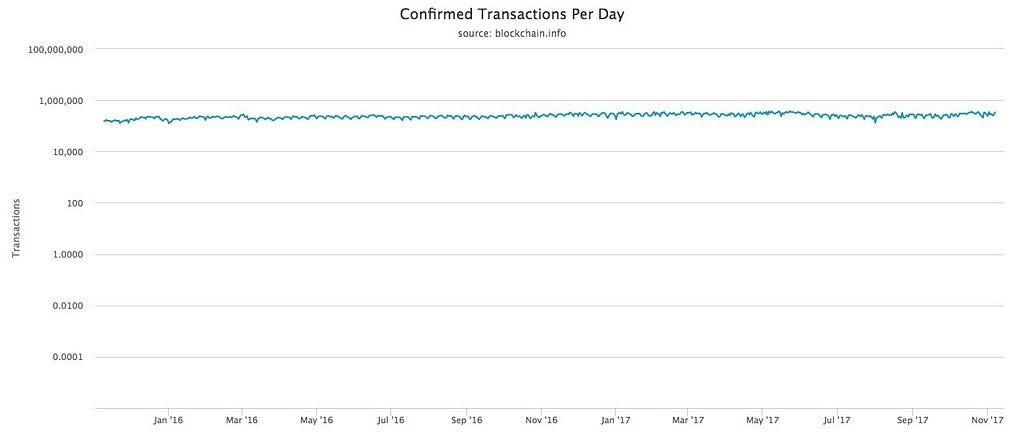
Yesterday, there were 274,858 transactions in the Bitcoin network. I made simple calculations with an Excel sheet. It turns out that last year there were 100,444,450 Bitcoin transactions. It follows that about US$ 1.9 billion per year in electricity costs are needed. This is just for sustaining transactions within the Bitcoin network. If the number of Bitcoin transactions equal those processed by Visa, then more than US$ 1.5 trillion per year would be required. Just to sustain the Bitcoin network. The anomaly of this sum is visible.

But, the Bitcoin network is restricted to a rate of 7 transactions per second. This is due to a protocol block size restriction of 1 MB set by Satoshi Nakamoto. This provides protection against hacker attacks.

An average number of operations last year required a speed of ~3 transactions per second. There was a plan called SegWit2X, which attempted to increase the block size. These plans are suspended.

The daily amount of confirmed transactions in the logarithmic scale for the last 2 years

The fact is that Bitcoin was intended for low-frequency operations with impressive sums. It isn’t capable of reaching the globalization level of Visa. Capitalization of Bitcoin has exceeded US$ 100 billion recently. The amount of daily transactions at that time was more than US$ 900 million.

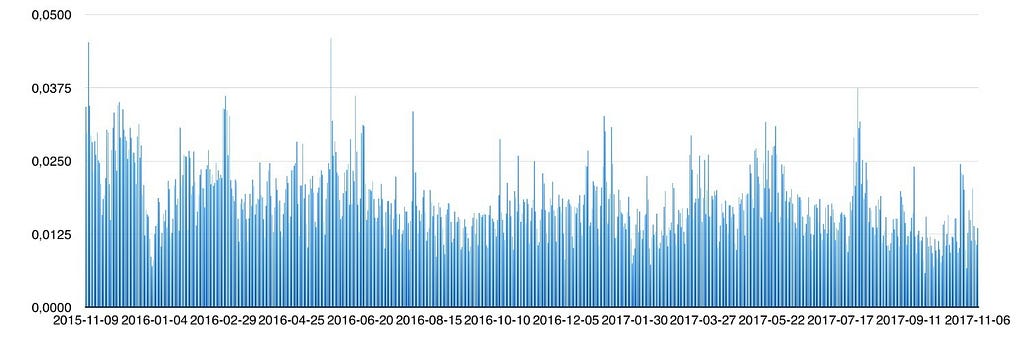
I wanted to analyze the relation of data for the estimated transaction volume to market capitalization for the last two years. As a result, the average value is equal to 1.79% (the median — 1.7%). What conclusions can be made from the obtained results?

  • Only ~1.8% of Bitcoins are circulating on the network. The remaining 98.2% are lying in accounts in anticipation of growth.
  • BTC growth is not in accordance to the law of supply and demand. For comparison, Visa’s total volume — $8.9 trillion, payments volume — US$ 6.3 trillion (this is 70% of total number).
  • The growth of cash transaction volume is proportional to the growth of market capitalization. And this does not increase in percentage.
The ratio of the transaction volume and market capitalization for the last 2 years

Earlier, I was convinced that the growth of BTC occurs because of the growth of cryptocurrency distribution. But it’s not so.

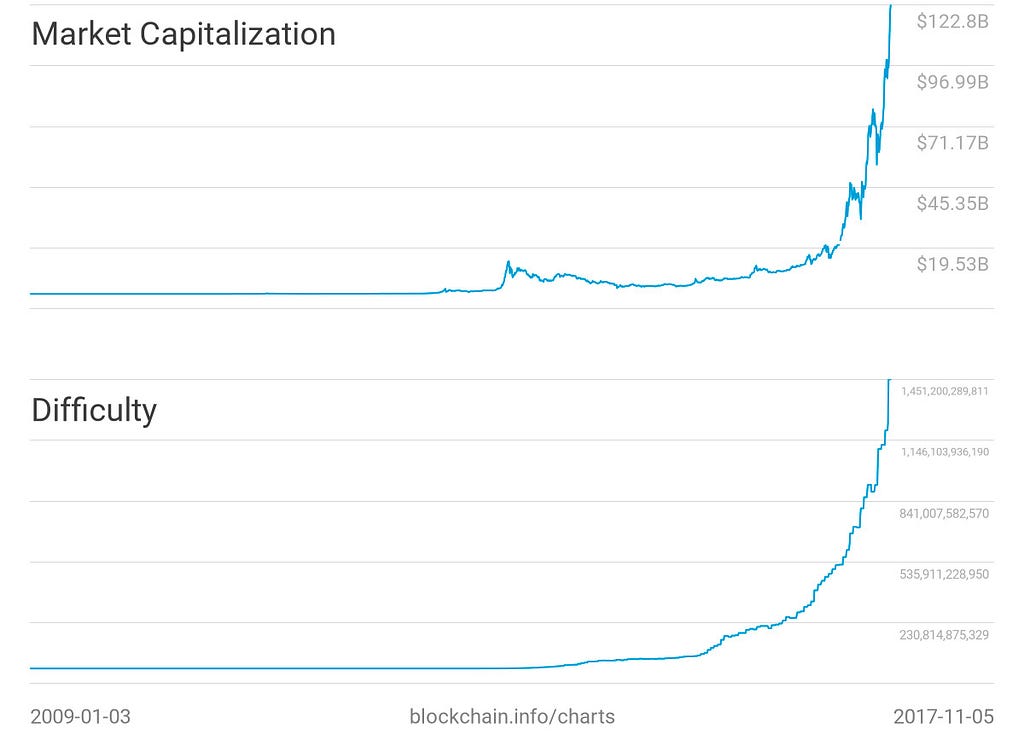
My previous statement, “If there were no such people who changed BTC to pizza, Bitcoin wouldn’t cost what it does today”, didn’t make sense. I want to emphasize that I didn’t wonder what exactly was the proof of the current BTC exchange rate. I was curious to find the cause. And the correlation between capitalization and level of difficulty is clear.

Difficulty and market capitalization charts of the entire Bitcoin history

Thus, we got surprising regularity. On one hand, the cost of transactions (difficulty) grows according to the monetary volume of these transactions. This increases together with the market formed by and large by miners. But, this “balance of payments” is provided by only 1.8% of total Bitcoins in number. And if capitalization was comparable to Visa, then an operation of US$ 1 requires US$ 1,400 worth of electricity. US$ 19.35 * Visa’s total volume / market cap of Bitcoin. Furthermore, there are fees in Bitcoin — the cost of Internet, equipment, etc.

The difficulty of Bitcoin mining is regulated artificially. And it is directly proportional to the cumulative computing power of the network. In statements that Bitcoin is a bubble, you certainly heard my previous arguments. Yes, if all nodes are disconnected from the network, except one old computer, it will get Bitcoins with the same speed of the whole network today. And “if all nodes are disconnected”, someone will begin to compute blocks in the opposite direction and the network will be hacked.

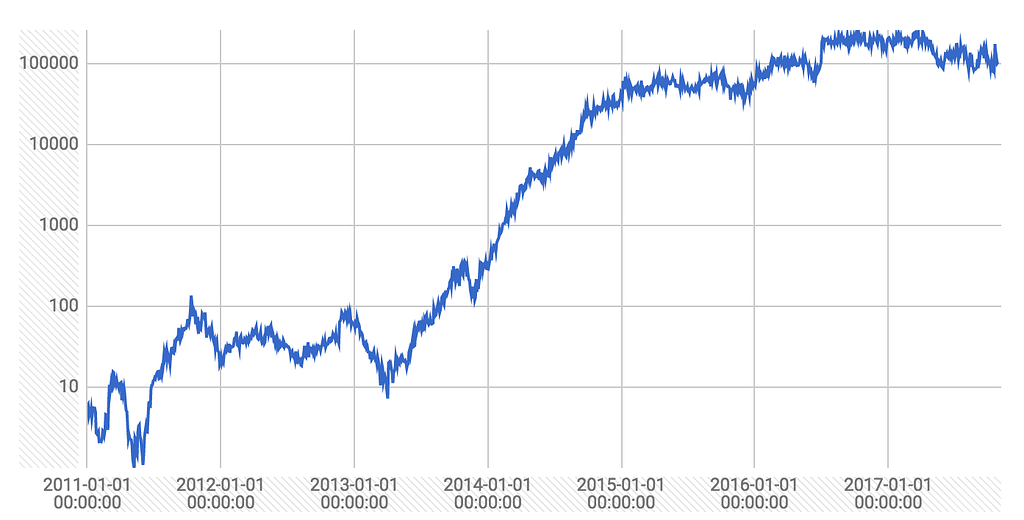
It is known that the speed of Bitcoin mining is constant and doesn’t depend on the total volume of computing capacities. Therefore, I wanted to look at the changing of difficulty level and revenue of miners. But as nothing was available, I have created the chart reflecting how many units of difficulty matched to US$ 1 throughout all time. There has been an almost exponential growth of computing power. This has led to the increased profitability of Bitcoin mining in recent times. This is due to the amazing growth of BTC price, of course.

Dependence of difficulty level and miners revenue in logarithmic scale

With such a market, the irrationality of operating where the sum made is less than the cost of operation becomes prevalent. But how long and quickly will these capacities increase is unknown. And don’t forget that Block Reward Halving comes nearer every day.

There are no doubts that electricity cost of the transactions has a limit. And if miner farms begin to close, then computing capacities will begin to decrease. In consequence, the cost of the transaction will lower to a certain norm, when it will stop to seem irrational.

But when all this happens, will the BTC exchange rate fall?

I think an attentive reader will say “Yes”. We have defined correlation of capitalization with miners and have revealed this vicious circle. Yes, but it doesn’t mean that BTC exchange rate will fall. We learned that contradiction with the law of supply and demand doesn’t prevent Bitcoin growth. Payment balance doesn’t allow adhering to that 20%, described by the economist Adam Smith. So why does our regularity have to remain? Bitcoin would cost as much as the market pays for it. And the economy, as George Soros had once mentioned, can’t be objective because the subjective human will always be its last element. Bitcoin exchange rate is our empirical understanding of cryptocurrency. But, it’s surprising how contradictory this idea is.


The Antinomy of Bitcoin was originally published in freeCodeCamp on Medium, where people are continuing the conversation by highlighting and responding to this story.

Read the whole story
pgilmore
3114 days ago
reply
Ystad, Sweden
Share this story
Delete
Next Page of Stories